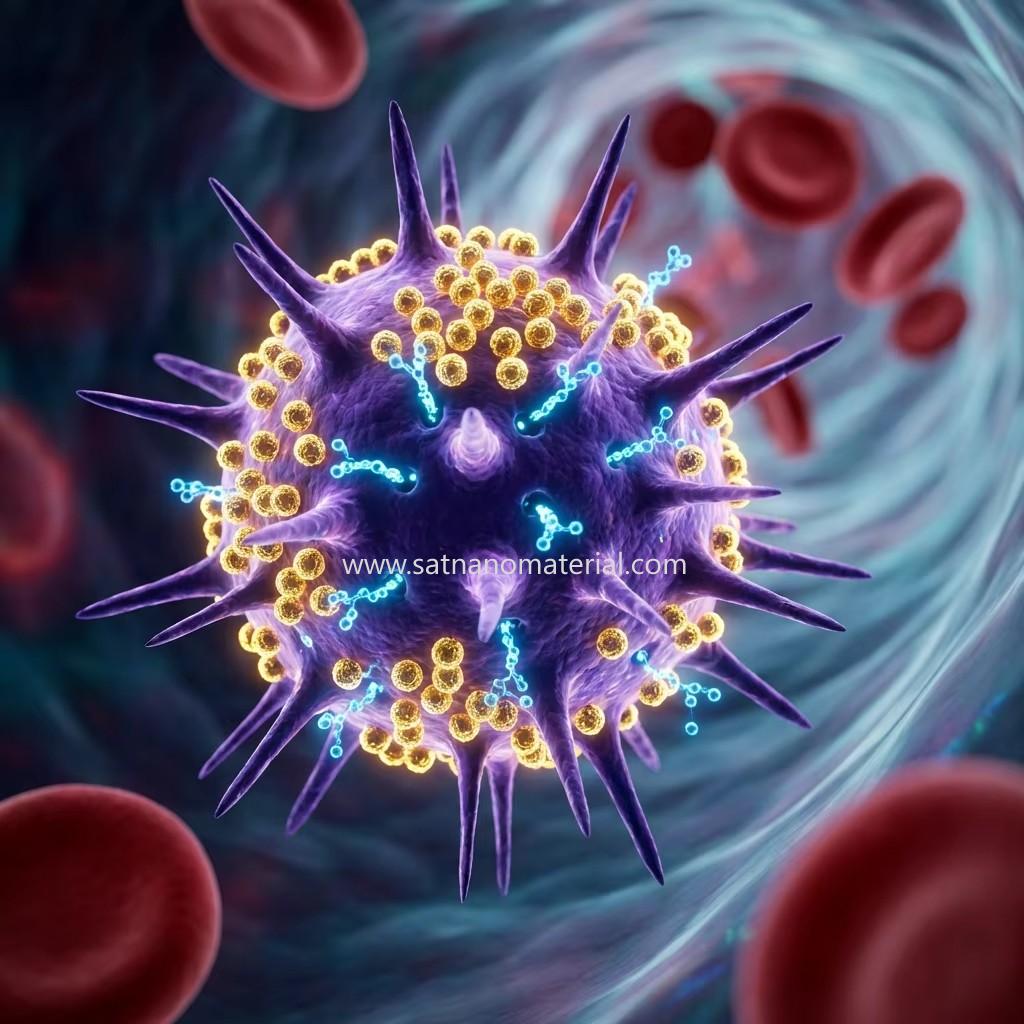
Gold nanoparticles refer to ultrafine gold particles with a particle size between 1 and 100 nanometers. Unlike macroscopic gold, nanoscale gold exhibits significant surface plasmon resonance (SPR) effects, quantum size effects, and a huge specific surface area. These characteristics endow it with excellent optical, electrical, and catalytic properties in complex biological environments. In addition, gold nanoparticles have become an important bridge between nanotechnology and clinical medicine due to their stable chemical properties and low biological toxicity.
1. Application in medical diagnosis
1.1 Biosensing and Rapid Detection
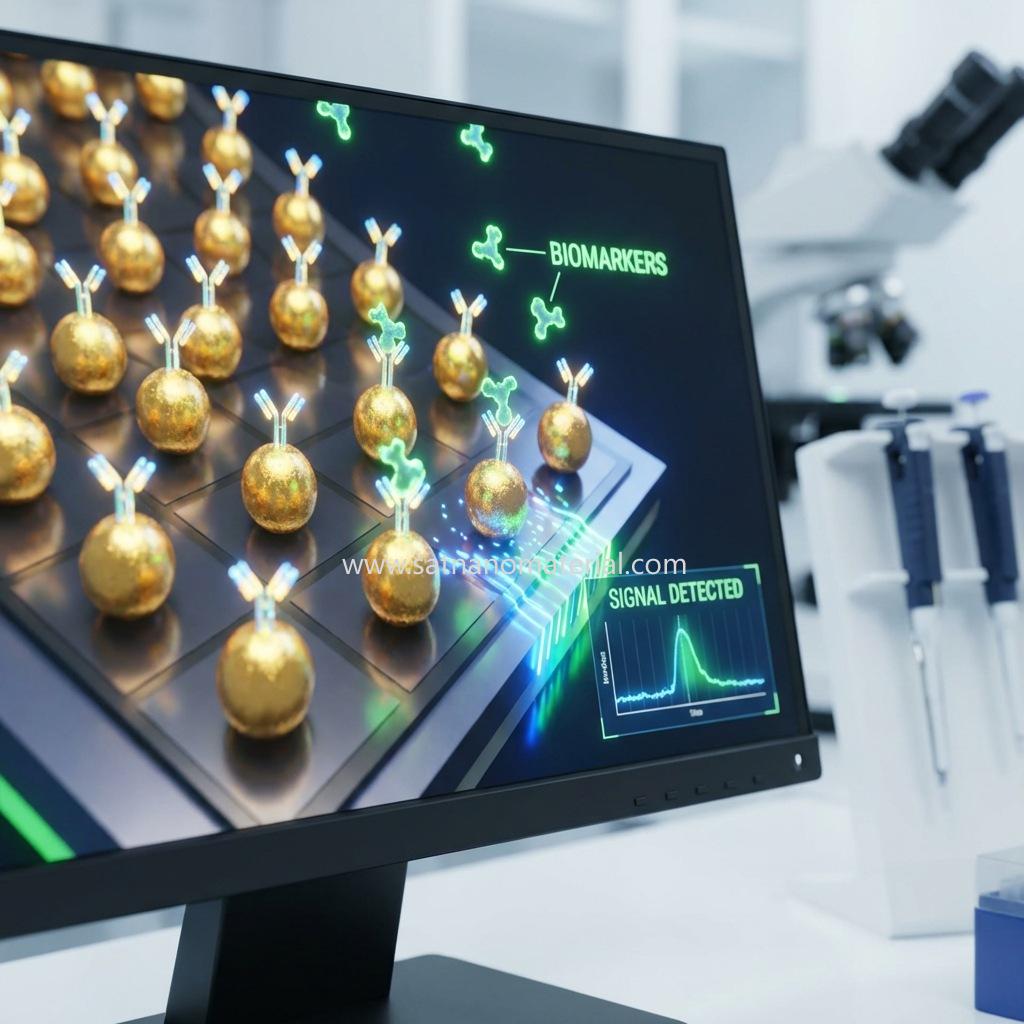
One of the most widely used applications of gold nanoparticles is as markers for in vitro diagnostics (IVD). The most typical case is side stream immunoassay (such as early pregnancy test paper and COVID-19 rapid detection test paper), which uses the strong absorbance and color change of gold nano powder to realize the signal detection visible to the naked eye.
1.2 Imaging contrast enhancement
The high atomic number of gold gives it excellent X-ray attenuation ability. Compared to traditional iodine contrast agents, gold nanoparticles as CT contrast agents have longer blood circulation time and lower renal toxicity. At the same time, its photothermal properties also make it play a key role in photoacoustic imaging (PAI), significantly improving the imaging contrast of tumor tissue.
2. Innovative applications in the field of treatment
2.1 Photothermal Therapy (PTT)
Gold nanoparticles can efficiently convert light energy into heat energy under near-infrared light irradiation. By surface functionalization modification (such as linking folate or antibodies), these nanoparticles can accurately aggregate at the tumor site. After laser irradiation, the locally generated high temperature is sufficient to kill cancer cells, while causing minimal damage to surrounding healthy tissues.

2.2 Radiation therapy sensitization
Since gold nanoparticles can absorb high-energy rays and release secondary electrons (photoelectrons and Auger electrons), the use of gold nanoparticles during radiotherapy can significantly increase the local radiation dose, thus improving the killing rate of tumor cells and reducing the exposure risk to normal tissues.
2.3 Targeted drug delivery
The huge specific surface area of gold nano powder allows it to load a large number of chemotherapy drugs, proteins or nucleic acids (DNA/RNA). By utilizing its surface thiol chemistry (Au-S bonds), scientists can easily graft ligands onto the surface of nanoparticles, achieving precise drug delivery and controlled release, thereby reducing systemic toxic side effects.

The different particle sizes of gold nanoparticles will have different applications. The following is the parameter data compiled by Gary, a technician from SAT NANO company.
3. Diameter/Size: This is the core parameter that affects the performance of gold nanoparticles.
3.1 Less than 20 nm: mainly used for drug delivery and renal clearance. For example, the diameter of particles used for drug delivery is often around 13-18 nm, while particles used for liver targeting can be controlled between 10-30 nm. Ultra small gold nanoclusters (such as Au ₂₅) are composed of precise 25 gold atoms and typically have a diameter less than 3 nm.
3.2 20-50 nm: Widely used in optical imaging and photothermal therapy, such as 3.19 nm particles for imaging and 25 × 47 nm gold nanorods used in photothermal therapy.
3.3 50-200 nm: Commonly used in scenarios that require high photothermal conversion efficiency, such as multi-layer gold nanostructures (<100 nm) used for tumor photothermal therapy and nanogold probes used for immunohistochemical detection. Studies have shown that larger spherical particles (approximately 102 nm) are actually more easily taken up by certain cells.

4. Optical properties: This is the basis for gold nanoparticles to be used for imaging and therapy.
4.1 Characteristic absorption peak (λ max): Spherical gold nanoparticles usually have an absorption peak around 520-530 nm, while gold nanorods have two plasmon resonance absorption peaks, horizontal and vertical. The vertical peak can be moved to the near-infrared region (usually 600-900 nm) by adjusting the aspect ratio of the rod. The light energy in this band penetrates deeper tissues, making it very suitable for photothermal therapy and deep tissue imaging.
4.2 Luminescence Characteristics: When used for biological imaging, high quantum yield (such as 12.9%) means brighter signals, while ultra long luminescence lifetime (about 1 microsecond) can be effectively shielded from background fluorescence of biological tissues through time gating technology, resulting in higher resolution images.
4.3 Surface Modification: In order to increase stability, biocompatibility, and targeting, the surface of gold nanoparticles usually needs to be "disguised".
4.4 PEG modification: Polyethylene glycol (PEG) is the most commonly used modifying molecule, which acts as a "invisibility cloak" for particles, reducing their clearance by the immune system and prolonging circulation time in the body. For example, PEG3000 modified 40 nm gold particles.
4.5 Targeted molecular modification: By connecting specific ligands, nanoparticles can accurately find their targets. For example, modifying GalNAc (N-acetylglucosamine) can achieve liver targeting; Connecting antibodies can be used for targeted imaging and treatment of tumors.
Overall, the choice of parameters for gold nanoparticles depends entirely on your specific application goals:
If the goal is high-resolution biological imaging, especially deep tissue imaging, the focus can be on particles with a size of a few nanometers, high quantum yield, and near-infrared luminescence characteristics.
If the target is photothermal therapy for tumors, it is necessary to choose particles with strong absorption in the near-infrared region (such as 808 nm) and high photothermal conversion efficiency (such as 77%), and their optimal size is usually below 100 nm.
If the goal is to build a targeted drug delivery system, particles with a particle size of 10-30 nm and a surface that is easy to modify with multiple functions (such as linking PEG and targeting ligands) are a more suitable choice.
SAT NANO is a best supplier of gold nanopowder in China, we can offer nano particle 20-30nm, if you need gold dispersion, we also can supply, if you have any enquiry, please feel free to contact us at admin@satnano.com