Carbon nanotubes (CNTs), as typical one-dimensional nanomaterials, have shown great potential for applications in various fields such as energy storage, composite materials, biomedical, electronic devices, etc. due to their excellent mechanical properties (100 times higher than steel), outstanding conductivity, excellent thermal properties, and unique optical properties. However, the strong van der Waals forces (~500 eV/µ m) and high aspect ratios (>1000) between CNTs make them prone to forming strong aggregates, severely limiting their excellent performance and practical applications. Therefore, achieving uniform and stable dispersion of CNTs in solvents or polymer matrices is a key prerequisite for unlocking their nanoscale properties and promoting their large-scale applications. The aggregation of CNTs is mainly due to their large specific surface area, strong van der Waals forces between tube walls, and π - π stacking interactions between delocalized π electron clouds formed by sp2 hybridized carbon atoms. This agglomeration not only reduces the specific surface area, but also hinders the formation of continuous conductive or reinforcing networks in the matrix. So far, two main methods have been developed for the dispersion of CNTs, namely covalent functionalization and non covalent functionalization. Covalent functionalization can significantly improve the dispersibility of CNTs by grafting soluble functional groups or hydrophilic chains onto them; Non covalent functionalization is achieved by adsorbing onto the sidewalls of CNTs through non covalent interactions (including van der Waals forces, hydrogen bonds, hydrophobic interactions, and electrostatic attraction, etc.) using added dispersants.
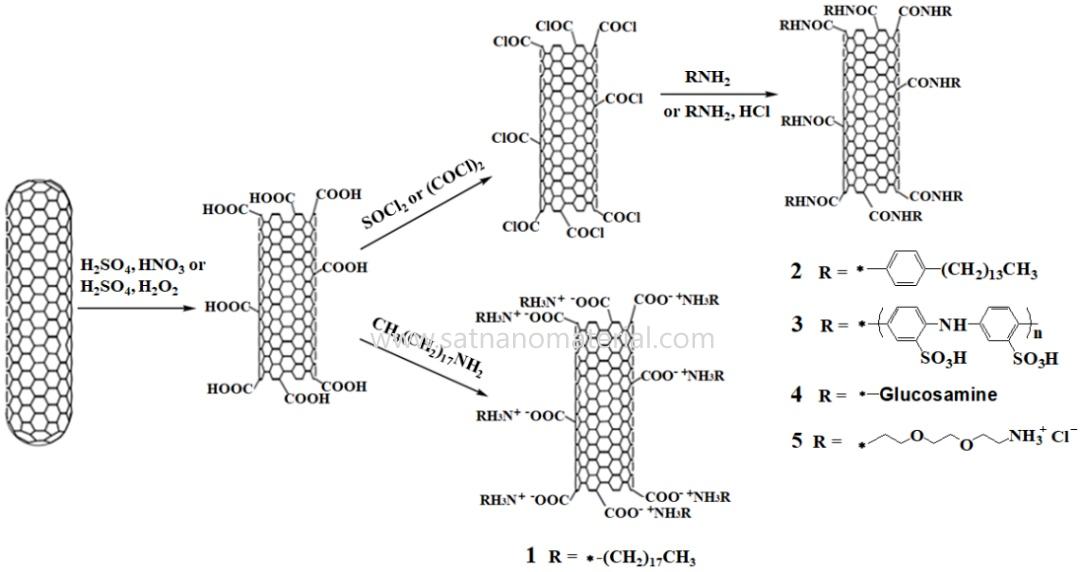
Currently, two methods have been developed for the indirect and direct chemical functionalization of CNTs sidewalls. The indirect method is usually to generate active sites on the surface of CNTs through chemical reactions. One of the most typical examples is to use strong acids to oxidize CNTs to generate oxygen-containing functional groups on their surface, such as - COOH, - CHO, and - OH. To further enhance the dispersibility of CNTs, further amination or acylation reactions can be performed to modify the sidewalls of CNTs. As shown in Figure 1, oxidized CNTs are directly coupled with octadecylamine (CH3 (CH2) 17NH2) through acid-base reactions to form zwitterions, or react with thionyl chloride (SOCl2) or oxalyl chloride ((COCl) 2) to form acyl chloride intermediates, which are then acylated with 4-tetradecylaniline (CH3 (CH2) 13C6H4NH2). After the reaction, the long alkyl chains attached to the surface of CNTs act as solubilizers, endowing them with good dispersibility in most organic solvents.
By grafting different types of long-chain alkyl groups, the dispersibility of CNTs in various solvents can be effectively regulated to meet different functional requirements. For example, grafting with water-soluble polymer poly (aminobenzenesulfonic acid) (PABS) can effectively improve the dispersibility of single-walled carbon nanotubes (SWCNTs) in aqueous solution, and the resulting SWCNT-PABS exhibits much higher conductivity than pure PABS. Functionalized CNTs with good dispersibility (0.1-0.3 mg/mL) were obtained by grafting glucosamine (C6H13NO5) onto activated CNTs with acyl chloride. By treating multi walled carbon nanotubes (MWCNTs) with strong acid (H2SO2/HNO2) and then grafting amino triethylene glycol chains to introduce positive charges, well dispersed functionalized MWCNTs can be obtained.
Figure 1 Covalent functionalization of CNTs through amidation reaction
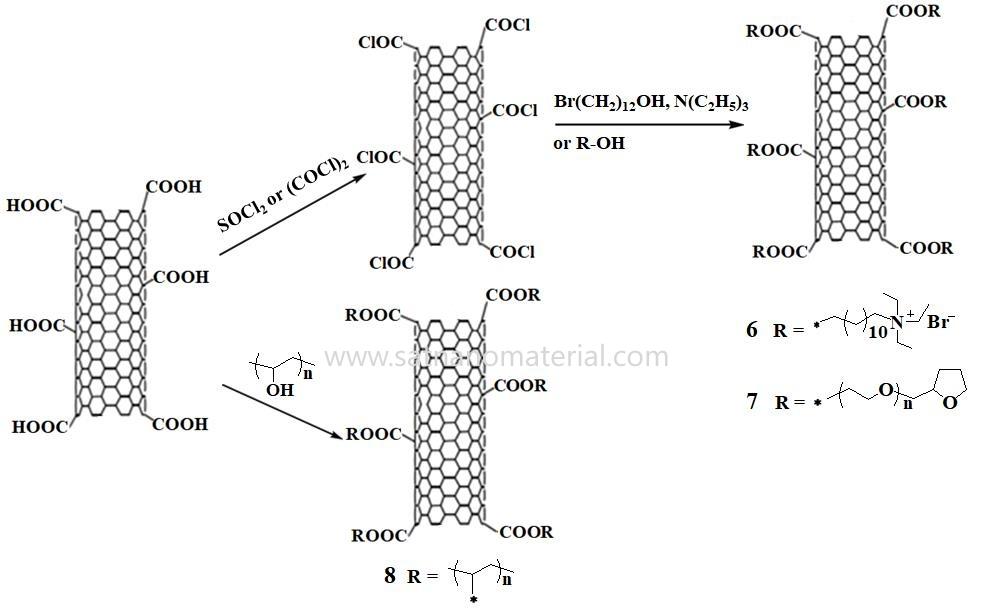
Esterification reaction is another effective method for covalent functionalization of CNTs (Figure 2). The SWCNTs functionalized with dodecyl quaternary ammonium bromide synthesized through esterification reaction (6 in Figure 2) exhibit good water dispersibility in the pH range of 6.87-11.25 and are used as fillers in polyvinyl alcohol (PVA) based composites. In addition, polymer segments such as polyethylene glycol (7 in Figure 2), PVA (8 in Figure 2), DNA, and proteins are covalently attached to the surface of CNTs through esterification or amidation reactions to pursue dispersibility in aqueous solutions.
Figure 2: Covalent functionalization of CNTs through lipidation reaction.
The condensation reaction between hydroxyl and silmethoxy groups has also been used for the chemical functionalization of CNTs. The reaction between hydroxylated CNTs and conductive carbon black grafted with poly (3-trimethoxysilylpropyl methacrylate) (CCB-PMPS) resulted in CNTs based hybrid fillers with good dispersibility in tetrahydrofuran (THF).
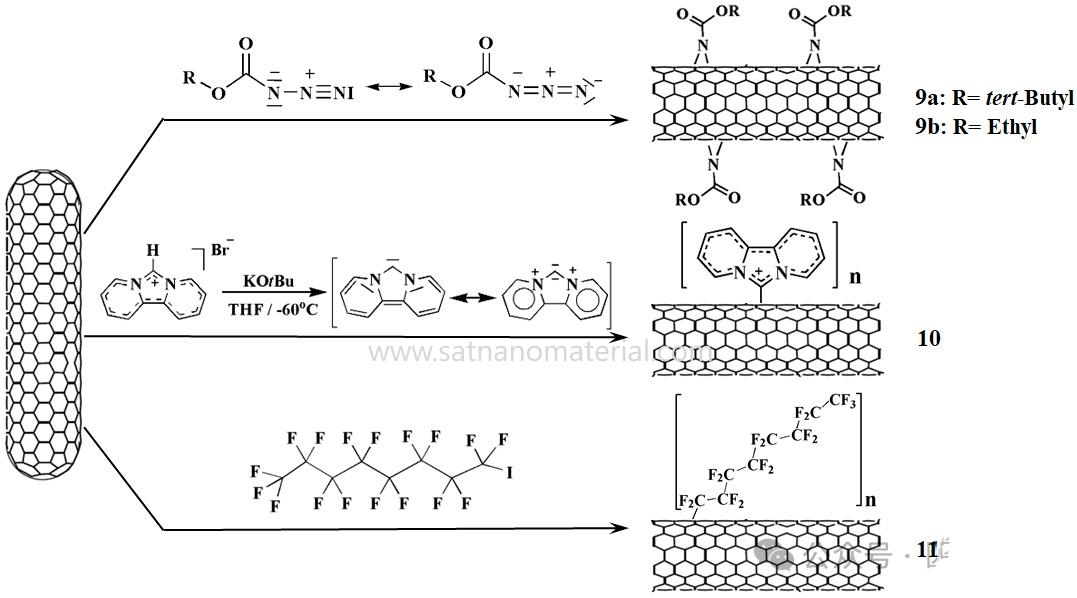
In addition to the indirect modification methods mentioned above, the direct functionalization of CNTs sidewalls has also been widely studied. CNTs can react with nitrogen alkenes, carbenes, imine ylides, or free radicals (or cycloaddition). Compared with indirect functionalization, direct functionalization can avoid the damage of strong acids or oxidation processes to CNTs, and prevent the shortening of CNT length. The following figure shows a schematic diagram of the direct functionalization of SWCNTs sidewalls. SWCNTs undergo addition reactions with nitrogen alkenes, nucleophilic carbenes, and perfluoroalkyl groups, respectively. It was found that the derived SWCNTs obtained by reacting with alkyl azide ester and bipyridine imidazolidine exhibited good dispersibility in dimethyl sulfoxide (DMSO). SWCNTs react with nitrogen-containing compounds with more complex substituents such as aryl, dendritic macromolecules, long alkyl chains, and oligopolyethylene glycol units, and exhibit good dispersibility in various organic solvents including 1,1,2,2-tetrachloroethane (TCE), DMSO, and 1,2-dichlorobenzene (1,2-DCB).
Figure 3 functionalizes the sidewalls of CNTs through the addition of nitrogen alkenes, nucleophilic carbenes, and free radicals.
The 1,3-dipolar cycloaddition of nitrogen-containing methyl alkali ylides generated by thermal condensation of alpha amino acids and aldehydes has been proven to be an effective method for functionalizing CNTs. Phenol groups can be grafted onto the surface of SWCNTs through 1,3-dipolar cycloaddition, achieving stable dispersion in polar solvents. By using aldehydes and modified glycine for grafting, products that can be dispersed in solvents such as CHCl3, CH2Cl2, acetone, methanol, ethanol, and water can be obtained. In addition, CNTs were functionalized with amine functionalized and water dispersible derivatives by reacting 1,3-dipolar cycloaddition with N-functionalized glycine with amino end groups protected by tert butoxycarbonyl (Boc) (Figure 4: CNT functionalization based on 1,3-dipolar cycloaddition reaction on CNT sidewalls). ). This process was subsequently used to prepare CNTs modified with amino acids and peptides for application in the biomedical field
The technical sharing of covalent modification and dispersion of carbon nanotubes above is completed by DANA, a technician at SAT NANO, through the dispersion of SAT NANO's carbon nanotube powder. I hope the above technical sharing will be helpful for customers to disperse covalently modified dispersed carbon nanotubes. Our technician DANA will introduce the dispersion technology of non covalent modified dispersed carbon nanotubes in the next article.
SAT NANO is a best supplier of carbon nanotube powder in China, if you have any enquiry, please feel free to contact us at admin@satnano.com